This is a travel blog for desktop travelers and other ramblers who want to know the world just a little bit better.

Right now I am living in Quetzaltenango, Guatemala where I'll be settled for a while. Thanks for reading!
Showing posts with label Colombia travel. Show all posts

Monday, February 7, 2011

On the Move to Ecuador Via Popayan

We are almost exactly in the center of Colombia. Our visas will end soon, and we have a directional decision to make: Do we head north or south? North leads to beautiful Cartagena and the Carribean, but then we will have to fly down the whole country going south to get to Ecuador and eventually Peru. So we decide to head south figuring that we will one day have to head north again to get to Los Estados Unidos, and we can visit the northern part of Colombia then.


View Larger Map

Our last few stops before visiting Colombia will be to visit the archaeology parks in San Augustin and Tierradentro and the indigenous market in the town of Silvia. To get to all these places it is almost necessary to pass through Popayan. The city itself does not have so much for the general traveler. It is usually just a one or two day stop on the way to/from Ecuador. Popayan ends up being one of these towns where Mika and I stay longer than most and end up doing a lot of not too much. It is probably a clear sign that we are getting road weary and need to find our place for a several month stay.


The historic center of Popayan is beautiful and easily seen in a day. The only thing I actually want to see here is a church that has two mummified monks. However, the policeman at the tourist office tells us there are not enough officers in town to manage the place.
I know mummies are in there somewhere.
Unlike other colonial towns in Colombia which are small and seem to be preserved mostly for tourism, Popayan is a thriving town where modern life continues within the walls of the old buildings. Churches and universities abound and almost the entire historical center is white, giving Popayan the nickname, "The White City."


Probably the biggest tourist draw to Popayan is the Tuesday market in Silvia, a town about 40 minutes away by bus. Every Tuesday hundreds of Guambino Indians (the indigenous community that has lived in the region for over 500 years) come from the surrounding villages to buy and sell goods and to socialize with friends and relatives. The Guambino are immediately recognizable by their traditional clothing and hats. The indoor market is actually not that large and does not take long to wander around it and the outlying streets. We buy some vegetables and fruit which end up being much cheaper than the supermarkets in Popayan.

Outside the market

An onion seller
Approximately 3,000 varieties of potatoes grow in the Andes.
Many of which are sold at this market. 


Chivas are colorful local buses going to small towns  
Vaya con Dios - the front of the bus
The back of the bus
From Popayan it is six to eight hours to the border with Ecuador. We mistakenly choose an eight hour bus so spend the night in Ipiales at the Colombian side of the border. Crossing the border into Ecuador the next morning, we are happy that we do not have to say adios to Colombia, but rather just hasta luego.

Sunday, January 30, 2011

That's More Archaeology! - Tierradentro

Since we really enjoyed the archaeology at San Augustin we decided that we should go check out Tierradentro, the other UNESCO archaeological park in the area. The first step is getting there. It turns out to be eight an ordeal that involves three seperate camionetas and a taxi. Camionetas are the most common form of public transportation in the region. A camioneta is a pick-up truck that has benches in the truck bed and a hard top cover (see photo below). They are usually stuffed with eight paying adults and at least two children. Plus five other passengers in the front of the truck and some on the roof and/or standing on to the back bumper. For most of this trip the roads are windy, dusty and uncomfortable. Mika and I never seem able to figure out how to secure a premium seat in the front of the truck. The only breaks from squishdom is having to stop for construction work and dump trucks which in itself is an inconvenience.
Hoping we can get going again soon, but also not.
We finally arrive to San Andres. It would be hard to call San Andres a town, it is more like a tiny village. We get dropped off at the top of the hill. The only noticeable restaurant that is here happens to be the same place as our hotel. There are a few small stores to buy bread, fruit and snacks. Two KM down the hill on the main road are some other guesthouses and a lady making really good fruit juice. There is also a museum.
The church of San Andres
Where as San Augustin is famous for its pre-Colombian stone statues and sculptures, people visit Tierradentro archaeological park to see the hypogeum. You do not know what "hypogeum" is? Well, I won't pretend that I did either before coming here. It is a fancy Greek word for an ancient, subterranean burial chamber. Whatever you want to call it, this mountainous area has lots of them to see and so many more undiscovered or known about and to be left in peace.

The clearing at the bottom of the photo is a burial site with numerous tombs

From San Andres, there are two very nice hikes going in opposite directions from the town to get to the Tierradentro sites. Some travelers with less time and in better shape than us do both sides in one day. One hike a day is plenty for us. On the first day we visit three sites. The first just has some statues. The other two have the burial chambers. There is an attendant/security guard there to open them for us so that we can go down. He walks us through each chamber unlocking and locking them one-by-one. I am not sure what he would do if other people showed up while he is with us. Tierradentro is definitely not ready yet for an influx of tourists.
Stairs leading down to a burial chamber
The hypogea vary in depth. The deeper chambers being reserved for the important people. The deepest one goes down seven meters (21 ft.). All of the chambers have stairwells leading down so that people could visit the tombs. The stairwells to visit the chamber are all original covered in cement so that they do not crumble. The larger chambers are in a semi-circular shape with pillars designed for support. There were up to seven bodies laid out in one chamber. Some still have detailed paintings that have survived time. Many have the same face carvings in the exact same locations. Small chambers of the poor people were found closer to the surface. Their bones just placed in ceramic pots.
Inside a hypogeum. Bodies were placed in the spaces
between the columns with a common face design.
A different decorated hypogeum
These pots contained the bones of the poor. 
On day two we do the other, longer hike. There are actually only two places to visit on this trail. The first is partially up the mountain and not too far from the town. The tombs are similar to what we saw yesterday. The second, El Aguacate is quite far. We have to finish going up one mountain trail, go all the way down and then back up and around even higher on another mountain. It is strenuous and the always green scenery is gorgeous. We finally reach the top and are rewarded with 360 degree mountain views. For the past two months we have been in the Andes, but this is the first time that we have been on the top of the Andes.


El Aguacate has only two burial chambers to visit, but it has the only hyogeum with salamanders painted on the walls. Your guess as to the significance of these reptiles is as good as anyone else's. There are no lights here and we are not allowed to use camera flash so we take the best photos we can using a flashlight.
Ancient lizard art
All of these sites and the museum can be visited for COP 10,000. The museum has artifacts and some skeletons that were found in the burial chambers. The other part of the museum is dedicated to the traditional ways of life of the people of the region. The highlight here is our introduction to the notorious coca leaf. Indigenous people have been chewing coca leaves in the Andean mountains for thousands of years. The leaf gives energy and helps stave off hunger. Coca leaves are not a narcotic in their natural state. A man-made chemical process is necessary to create cocaine.

Follow the link to read an interesting op-ed piece from the President of Bolivia regarding the coca leaf.

At the museum there is a coca tree in the garden (and pretty much everywhere else). The woman working at the museum gives us some dried coca leaves from their museum display for us to try - though you are supposed to stick wads of them in your mouth and ad a little lime (the mineral, not fruit). Tired from our hike, Mika claims that chewing the coca gave her the energy boost to trudge up the hill to our hotel. I am not sure about that, but it did make my mouth slightly numb. In San Andres we also have coca tea (coca leaves in boiling water) and try a locally produced coca wine which tastes like a cheap plum wine. Because there is such a stigma attached to the coca plant in my country, having drinks made from the leaves feels kind of naughty and rebellious.
How can one lttle leaf cause so many problems?

Monday, January 24, 2011

Fallin' for Hot Springs Near Pereira

We go to Pereira in search of more hot springs (aguas termales in Spanish). We like hot springs. The city Pereira itself is quite uninteresting for the international tourist and probably also the Colombian tourist. The highlight in town is the sculpture Bolivar Desnuda (Naked Bolivar) at the Plaza Bolivar. The leader of independence, Simon Bolivar, is seen riding his trusty steed in nothing but his birthday suit. This is quite a modern interpretation compared to the hundreds of clothed Bolivar statues in the rest of the country.

I wonder if there are any naked George Washington statues in the USA?
View from hotel entrance
The hot springs are just outside of a small town called Santa Rosa which is about a 40 minute ride from central Pereira with one bus change or straight from the terminal. From Santa Rosa you can wait for the public bus or hire a taxi. We get some wrong price information about the bus and make the mistake of hiring a taxi which is quite expensive for the 9 KM ride. We should have waited for the bus.

Here there are two places to enjoy the hot springs. One is a public park that has four pools. The other is 1 KM farther up the road at a nice hotel. Both places have doubled their prices during the high season (it is also Colombian vacation time) and Mika and I, after paying for the taxi, do not have enough cash. The public pools do not take credit card so we walk up to the hotel. They charge COP 35,000 (US $18.42) which is a little more than the park below, but thankfully take plastic. With transportation costs, this is turning out to be one of our most expensive days, but we have come this far and are not going to turn back now. There is a minimum charge of COP 140,000 so I pay the entrance fee and get the rest back in cash. It is a large pool, with a wall of green on one side that carries all the way up a hill to the side of a mountain with a 70 m. waterfall. From the hotel there is a short trail leading up to the bottom of this cascade. We decide first to check this out before getting in the hot spring pool. The water coming down from the falls is absolutely freezing.
The busy soaking pool during high season
Heading back from the waterfall I have the not-so-clever idea to scale a large boulder wearing wet flip flops and holding our lunch in one hand. I slip off the rock and fall down an adjacent wall. The wall is about 6 feet (two meters) high. Directly under me there is a small tree which in theory should help break my fall, but it actually inverts me. Instead of landing on my feet I flip and land on a rock bed in a cold stream flush on my left side. Luckily I do not hit my head. My left shoulder, thigh and rib cage take the brunt of the fall. I manage to get up relatively quickly, but our lunch is lost in the creek. Mika inspects my sore bones, scratches, and welts. I think all organs are intact. It feels like I just got my butt kicked. At least there is no blood.
The spot of the fall and the not-so-soft landing
I gingerly get down to the pool and sit in the hot springs. With no travel insurance, I have to put my faith in the mineral water’s natural healing powers. In the Americas, indigenous communities have believed in the medicinal properties of hot springs for thousands of years. While in Japan, samurai would soak in the onsen after battle. Let’s hope this works….and that I do not have any internal bleeding.
Hot springs take me away
The place here is actually quite nice and the hot springs pool ambiance is much better than the one in Paipa. At one end of the hotel’s pool is a waterfall where the very hot, hot springs mineral water cascades down into the bathing area. We sit directly under the hot water to get a hot water massage. As you move away from the source water, the pool temperature gets gradually cooler. At the opposite end from the hot waterfall and just away from the main pool are another two waterfalls that are raining down freezing cold water collected from the base of the giant waterfall above. Mika and I complete our own circuit of going from hot waterfall to freezing waterfall and back to hot waterfall five times to improve our blood circulation and maximize the benefits of the hot spring.

Freezing water
Hot water. And repeat...


A pastry oozing with arequipe -
also known as dulce de leche
After the hot spring outing, we stay in Pereira two more days longer than planned because: Extra Day 1 - sitting for a multi-hour, bumpy bus ride with my cracked rib and/or bruised pancreas does not seem feasible and Extra Day 2 - we miss the last bus to Popayan because it left thirty minutes early. Who’s ever heard of a bus leaving early in Colombia? Our days in Pereira are spent looking for a soap dish (mine was left at our last hotel), searching for the best bakery in town, and going to our first movie in Colombia at a modern theatre comparable to most in North America. Tickets cost just COP 5,000 (US $2.63), COP 10,000 for a movie in 3-D. A great bargain for the road weary traveler searching for a bit of luxury.

The International Rambler Travel Tip:
Some practical information for visiting these hot springs. Stay in Santa Rosa, not Pereira. There are a few hotels in Santa Rosa town and many more (for all budgets) on the road to the hot springs. If possible, do not go during high season - Dec/Jan. Their prices are slightly exaggerated and it is so busy with people. If in Pereira, the tourist information office at the bus terminal offers a tour to San Vicente, another eco-hot springs farther away that looks nice, for COP 55,000. This includes transportation, entrance and lunch. We spent just slightly less going to Santa Rosa and the tour seems hassle free.

The International Rambler Medical Update: We definitely believe the hot springs helped speed along my healing process. The swollen lumps on my left arm and thigh went down more quickly than normal with very little bruising. My left ribcage hurt for several days. Sleeping was uncomfortable for about a week as I could only lay on my right side or stomach. Taking very deep breaths also hurt, which was mildly concerning. But I was not in agony. I figured that it would probably be much worse if a rib was cracked or broken. Right? Anyway, I am fine now and am avoiding more rock climbing in flip flops.
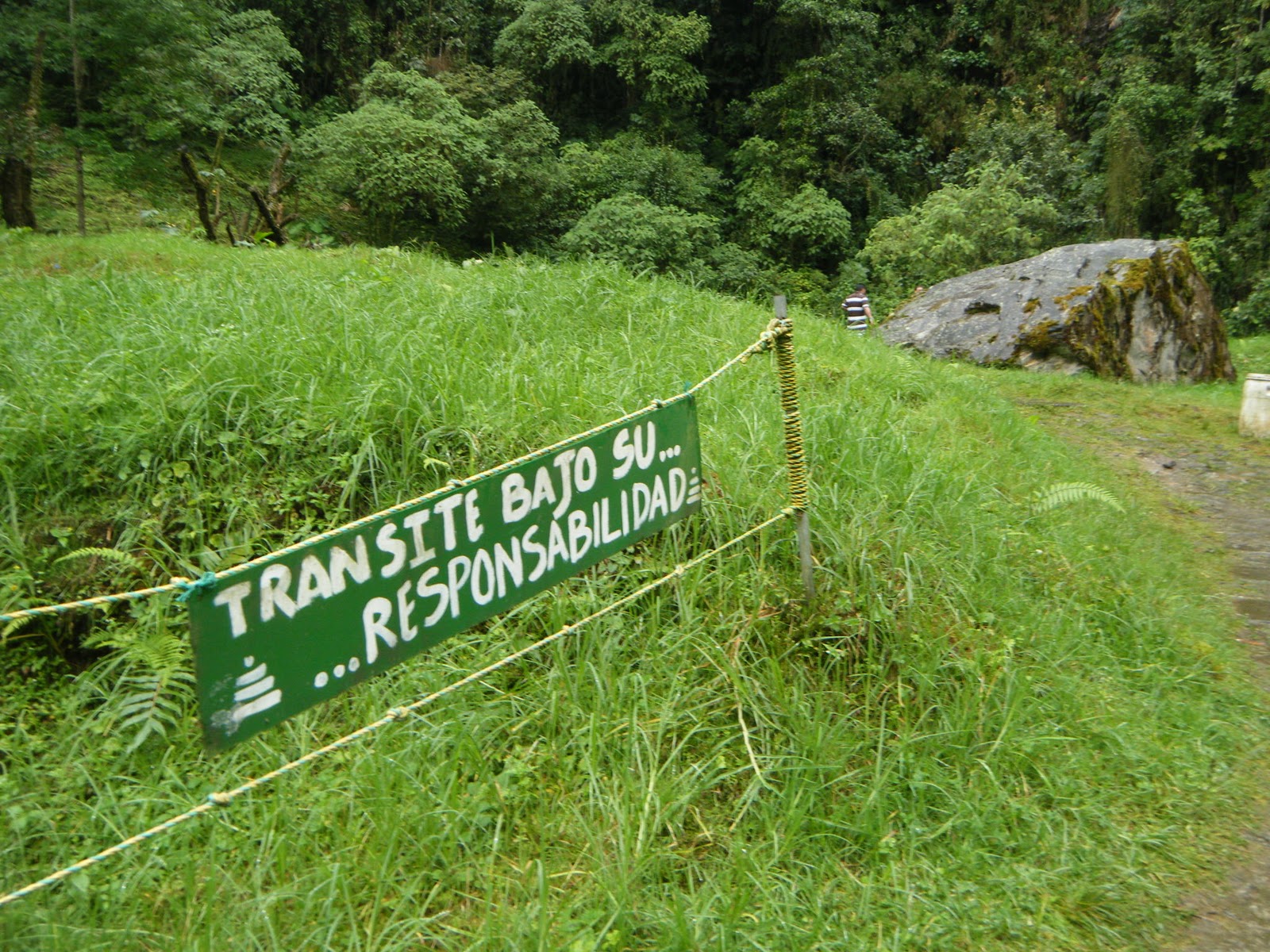
The sign from above leading back down to the pool says
"going down is your own responsibility." 
 

Friday, January 14, 2011

Coffee, Wax Palms and Gunpowder in Salento


Colonial
Salento is a small colonial town north of Cali and in the heart of the coffee growing region of Colombia. It is quite a small town, but it is a weekend destination for locals. We also start to hear more and more from foreign travelers about the town. It sounds like Salento is well-established on the Gringo Trail. But everyone says it is a lovely, quiet place surrounded by nature. Perfect after our week of Rumba in Cali. From Cali it takes a few hours to Armenia and then a short 40 min. bus ride to Salento.


View Larger Map

Like other older, traditional towns that we have been to, Salento's streets are lined with bleached white buildings. However, unlike other places, Salento's buildings have very colorfully painted doors, windows, balconies and trim. It gives a happy feeling. Older woman also seem to have their heads out the windows checking out what is happening on the streets, which is probably usually not too much.


Overall, Salento is a great place to visit for people looking for a tranquil place to hang their hat for a couple days, or even a week. I have the feeling that for better or worse it will become a major foreigner destination. New hostels geared towards gringos are already sprouting up. If you are into nightlife there is not much here, but with so many Colombian visitors fun can always be found. Buying and drinking beer outside of a mini-market can make a small party in Colombia.

Street Performers
Unknowingly, we arrive a couple days before Salento's own feria is starting. A stage and food tents are already set up in the town's main plaza. One night we go out to see what is happening since it is only one block from our hostel and we hear the music anyway. There is live music by a pretty lively military band. A few steps away there is a disco tent with around twenty large speakers and next to that is a bar tent. They are all cranking their own tunes competing for our eardrums' attention. The mix of loud sounds with no clear winner is discomforting and takes away from the small town charm of Salento. 

Coffee
Coffee bushes and banana trees

Because Salento sits squarely in the Zona Cafeteria there are several coffee plantations to visit and accessible with a short hike past rolling green hills and vistas of the Andes mountains. Somehow our hike we miss the nearest plantation and end up walking farther to Finca El Ocaso, an organic coffee grower. There are over 3,000 coffee plantations in the area and about 10% are organic. El Ocaso's coffee gets sent to Armenia (nearest large city) and mixed with other beans from other organic plantations. For COP 5,000 pp we get a quick tour of the plantation with an explanation of the entire coffee production process plus two cups of coffee.

Drying the beans


Wax palm
 
Cocora Valley
Maybe the highlight of Salento is visiting the Valle de Cocora. From Salento it is about a half hour ride (COP 3000 one way) in a jeep taxi to the entrance. This area is famous for the wax palms, Colombia's national tree. They grow in the high altitudes of the Andean mountains and only in Colombia and parts of Ecuador. Seeing an indigenous palm tree so far from the ocean is beautiful and strange.

Immediately getting out of the taxis we are greeted by guides trying to rent us horses. Because of all the rain recently the trails are quite muddy. We decide to take horses more for the novelty of riding horses than for avoiding the mud. We pay COP 20,000 (US $10) each for 90 minutes on horseback with a guide who walks along with us.* I have not ridden a horse in over twenty years, while this will be Mika's first time ever. Though it is not actually riding, just sort of sitting. The horses and guide do all of the work.

It has been raining constantly in Salento, but luckily we have a beautiful day with blue sky. The horses slog through the muddy trail as we enjoy the endless green mountains sprouting the wax palms. Our destination is a small waterfall that sits just inside the entrance of a cloud forest. With all of the commotion of people and horses it would be impossible to see any wildlife here. The trail continues further ahead about another two hours on foot to a place where twenty-five different species of hummingbirds reside.  It would be great to see, but we already paid for the return horse trip. Half way back I am already very tired of being on a horse, my butt hurts and am about ready to dismount my steed and walk the rest of the way. A true city slicker I am. We do get to trot a very short bit, but we feel kind of guilty doing it because the guide has to run alongside the horses.


* The International Rambler Travel Tip:
Be leery of anyone selling a horse tour who says that the road is too difficult, too far, or too muddy to walk. Make sure to ask if the guide is riding or walking. One time in China I was sold on a horse ride to a campground that was so difficult to reach walking. After mounting my horse I discovered that actually my horse would be led by a thirteen year old girl on foot! I would just sit on the saddle like a bourgeoise prat. Needless to say, I got off the horse, got my money back and had a fantastic hike to the location.

Trout

Just trout served here

It is nearly impossible to leave Salento without having trout (trucha). I would say that about 90% of restaurants serve trout and some serve only trout. There are several fish farms in the area to supply all the restaurants. A trout meal costs between COP 10,000 and 22,000 (US $5 - $11)depending on which restaurant and the type of fixin's. The price will include rice, patacon (a flattened and fried plantain) and juice. We go all in and get trucha al ajillo - cooked in garlic sauce - with mushrooms, cheese and shrimp. It arrives to our table still boiling. It is maybe our best meal in Colombia thus far.

Trout. It's what's for lunch
Tejo


Tejo is an official national sport of Colombia that dates back to pre-Hispanic days. I am not totally sure but it might only be played in this country. The game is sort of like horseshoes or lawn darts. The idea is to throw a metal disc at a ring imbedded in mud. The one that is closest to the ring gets the points. It can be played as individuals or in teams. But there is a kicker... four little packets of gunpowder are placed on the target and with a good throw there will be an explosion.

The tejo target
Tejo is all over Colombia, but Salento is the first place that we try it. It is free to play. The only requirement is to buy a drink. Beer is the tejo player's preferred beverage. In an actual tejo match the losers buy the brew. The tejo targets are 18 meters (59 feet) apart. They put foreigners, like us, at a kiddie court about half the official distance so that we do not kill any locals. Tejo is good fun and a real must-do in Colombia. Nobody forgets their first tejo explosion.
Playing tejo

Tuesday, January 11, 2011

Mucha Rumba at the Feria de Cali


View Larger Map

Rumba is a word used in Colombian Spanish to mean partying, nightlife, drinking, fiesta, etc, etc. If you come to Colombia you will find Rumba and if not Rumba will definitely find you.

We are heading south to Cali so have to come back through Bogota for a night which happens to be Christmas Eve. Nightlife does not start until after 11 PM because people are having Christmas with their family. Around midnight we go to a bar next to our hotel. Afterwards to a salsa/reggae after party hosted by a Jamaican dude we met last week at a free Hari Krishna vegetarian dinner. Going to bed at 4:00 AM is just foreshadowing of things to come.

The feria is very big in Colombia. Ferias are multi day festivals that have several events going on. The big ones will include bullfights, beauty pageants, concerts, parades and parties. No matter what the size of the feria there is sure to be lots of Rumba and even more alcohol.

It was recommended by several people that we go to the Feria de Cali -- “Mucha Rumba.” So we make the effort to book a hotel online and to deviate greatly from our general travel direction to get to the Feria de Cali. The city is Colombia’s third largest and their festival is one of the biggest in the country. The venues in Calí are spread all around the city and we either have to manage the indirect bus system or take taxis. Many of the events are free and just require that we bring a donation of a pound of rice or salt which will go to recent flood victims.

Our hostel is completely packed with travelers from every continent. Everyone is there for the revelry and it is very easy to make friends and drinking buddies. One night at our place more people are awake at 4 AM than asleep. And because we booked late we were stuck in a dormitory. With people returning to their beds at 7 AM and others checking out at 9 AM, a long snooze is hard to come by. Since taking the night bus from Bogota during most of the feria I feel like I am jet lagged from lack of quality sleep.

Photo courtesy of Juyeon Park
Cali happens to be the salsa capital of Colombia so it is quite fitting that the first big feria event we attend is a salsa performance. We arrive to the open air stadium half way through the show and are still there for more than two hours watching one dance school after the other perform their short routines. The groups range from a lone couple to teams of fifteen people or more. The dancers’ ages vary from elementary school to retirement home. Many of the performers are amazing dancers at an age when I was still tripping over my feet slow dancing at bar mitzvahs.

There are various different styles of salsa dancing (e.g. New York style, Cuban style). Cali style is famous for its very fast leg movements. Take that 1..2..1..2 you learned at the free salsa class at your local YMCA -- or at church, in college, on a how to DVD -- add a step and crank it up times 50. That is what we are seeing now. Watching just the speed of their legs is mesmerizing, then they add intricate twists and lifts all synchronized to the music and smiling all the while. The show ends with a stunning international competition winning team from Cali.

**I used a low-quality point and shoot camera, so please ignore the horrible sound quality and focus on the dancers:


Every night there are free salsa concerts. The venue is very fittingly at an old liquor distillery. The first time we go, we wait for over an hour, but it is well worth it. There must be several thousand people here. Many have brought their own cowbells and maracas to create a surround sound percussion section. The music, dancing and drinking carries on until 3:00 AM then we go to a salsa bar until 4:30 AM.

Here is a clip from the concert. Try to ignore the camera quality and focus on the Rumba going on around me. If you can hear, the band and audience are singing a song "Cali, Cali, Calidad" playing off the Spanish word calidad ( 'quality' in English). This really gets the crowd going:

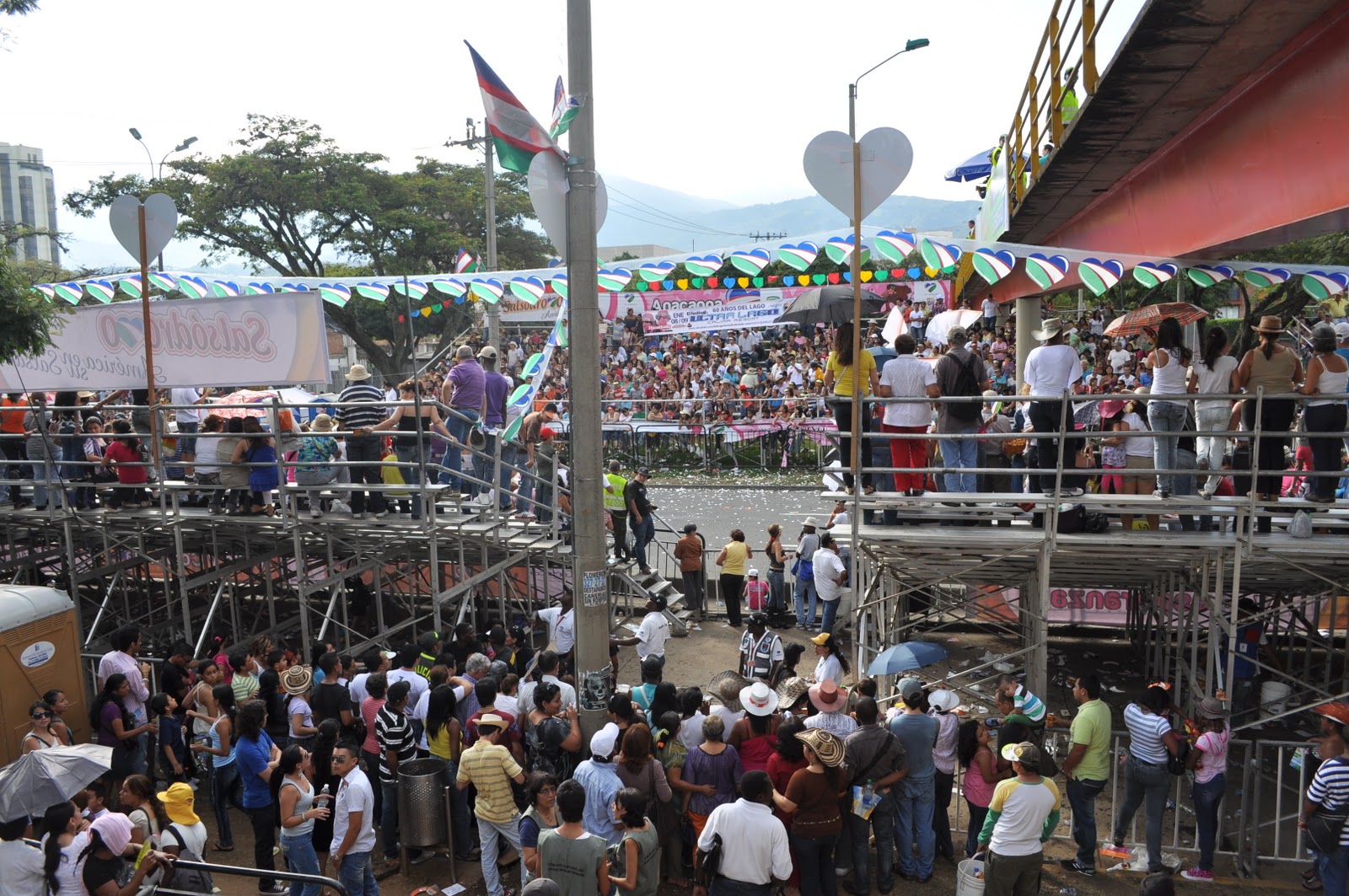
There are also some non-rumba related activities at the Feria de Cali. There are parades every afternoon and bullfights every early evening. Click here to see our day at the bullfight. There is also a temporary amusement park and a beauty pageant which we missed, but I caught some of it on the news. Lines are huge almost everywhere and all Colombians do not seem to be so civil about queueing up as they are in say UK or Japan. On the final day of the feria we wait two and a half hours in a long winding line only to be told that it is full. All because of people hundreds of people cutting in line with very little if any organization. We leave very disappointed. The Cuban band playing is supposed to be amazing. Drat!
View as we are leaving the parade (hot and boring). The people on the ground
are waiting to enter the too packed bleachers.
We have fun just walking around the amusement park and watching families have fun.
Adults and kids are waiting in ridiculously long lines for 30 sec rides.
Time to buy stock in Pop-A-Shot International. Nobody gets anywhere near
to the 240 points necessary to win a stuffed animal.
The Feria de Cali ends but New Year's Eve comes right after. There is a big party with everyone in our hostel. Unlike other Latin American places (and New York City) the streets are strangely quiet. Like at Christmas, everyone celebrates at home and then goes out much later. Our hostel party disperses at 2 AM and we go to a salsa bar which is just starting to pick up then. It is a retro 70's style club. We do not get to our bed until after 6 AM. By this time we are definitely Cali-d and Rumba-d out and ready for somewhere more tranquil. But we are too tired to leave on the 2nd. So on January 3rd we plan to head to a small, quiet  town.

With all of the Rumba we barely see anything of Cali. However, we do
manage one afternoon to drag ourselves to the art museum and visit El Gato del Rio