This is a travel blog for desktop travelers and other ramblers who want to know the world just a little bit better.

Right now I am living in Quetzaltenango, Guatemala where I'll be settled for a while. Thanks for reading!
Showing posts with label Arequipa. Show all posts

Monday, September 19, 2011

Vamos A La Playa - Sort Of


Backtracking

In Bolivia I became quite lethargic with traveling, however, crossing the border into Peru completely rejuvenated me. I know it is just mental, but it's like the ink in the custom officer's stamp was mixed with magic fairy dust. I get back on the bus telling Mika that it feels like we are starting a new trip. It is a good thing to that I am reenergized because we are about to do some heavy duty traveling.

The first thing we have to do in Peru is backtrack. Nobody likes backtracking, but it is as good excuse as any for me to add links to my older blog posts. The first stop is Puno on the Peruvian side of Lake Titicaca. If you remember we were there during large protests (click the link to read about Puno). The central plaza was completely occupied by campesinos and the town was a mess. This time around the place seems to be pretty normal: the plaza is empty, stores are open and bank windows are not smashed. With no sight-seeing on the agenda we go to a Chinese restaurant that we went to before and go to bed early to catch our next bus to Arequipa.
Bring back the Classics: Watching Splash dubbed in Spanish on the bus
The ride to Arequipa passes through a national park with mountain views, alpaca herds and vicuna spotting. This is the third time we have passed through here by bus. We also know Arequipa (click the link) and have no sight-seeing agenda. The only thing we plan to do is to go to the central market to eat salteñas (a stuffed pastry) for 1 Soles (US $0.36) which are the best we have found in South America. But Arequipa is a beautiful, safe town and there could be worse places to have to backtrack to. By chance we run into some friends that we know from Sucre, Bolivia and meet them for dinner. Packing up to leave the next morning I learn that my suitcase zipper is broken which means one more day in Arequipa to go suitcase shopping.
Hello again alpacas in the national park near Arequipa

Our salteña lady

The tourist info said that we can't leave Arequipa without trying ricotta relleno (stuffed pepper), and we didn't.

To the Beach and off the Trail

From Arequipa we make the very conscious decision to get off the tourist trail. While in Bolivia we never left it, and that scene can get tiring. We are commodities and a human-to-human element is lost during interactions with locals. Most tourists don't seem to care because either they have limited time with a "must-see" list, or they like guide books, hostels and restaurants that simplify backpacking to a sterile English-speaking environment, or they are Israeli.

The first place we go is Camana. During the summer this beach town is full of Arequipeños, but now is Peruvian winter and we might just be the only tourists international or local. The people at manning the tourist info desk inside the central library seem surprised to see us. To say that nothing is going on in Camana during their low season might be a grave understatement. An example: Our first night coincides with a woman from Camana being a contestant on a nationally televised game show. What's the big deal, right? Well, absolutely every single street level television in town is tuned into this program while the government is showing it on a giant screen in the central plaza to an audience of about fifty people. This is a huge event for Camana.
Camana market
We settle in town not far from the plaza and take a long walk to the beach. Beeeeeaaaaaachchchchch! Ocean, waves, wind and sand rocks. Rocks. Camana does have one sandy beach a few kilometers away that we could reach by taxi, but it is too cold to swim anyway. I accept the rocks. We made it to the Pacific coast. Mission accomplished... sort of. Without much to do we just spend our time figuring out where to eat. Camana has a small, active market with people eating ceviches and chilcano (a fish soup) in the morning and at fried rice and noodle stalls at night. People in Camana are very nice to us. Tourists are rare but not totally uncommon. We are a mild curiosity not a commodity.
Chilcano: A typical breakfast in Camana

Lapas in the market.
We eat these several times without knowing what they are. One internet dictionary says 'lipset' a type of mollusk. Another said 'barnacle.'

The Pacific Ocean
Having our morning coffee in the market

It's All About the Shrimp
Serious about their crustaceans: Camana's shrimp statue in the middle of town
Mention to any Peruvian that you went to Camana and the first thing they'll say is "shrimp." This town is famous for its flourishing shrimp populations and this is the real reason we are here because we kind of new the beach would not be ideal. After three months of eating fish from Lake Titicaca in Bolivia we are ready for some proper seafood. Camana does not disappoint.
Popcorn shrimp sold on the street

Sudado de camarones: a creamed tomato-based soup with a mountain of shrimp
Cholesterol count? Chicharron of seafood and fish

Last Stop
View of Chala and the ocean from our hotel
From Camana we take one more short bus ride to Chala. As the bus comes into town on the coastal road immediately we are thinking of why are we getting off here -- this will happen sometimes when off the tourist trail. The idea is to go see some nature outside of town, but it seems a bit difficult without our own transportation. Chala is a dirty town, every side street or alley heading down to the ocean smells like urine, and the food situation is bleak and weather sucks. We make plans for a quick exit the next day without knowing that we are about to plow head-on into the tourist trail.

View Larger Map

A) Copacabana, Bolivia   B) Puno, Peru   C) Arequipa, Peru
D) Camana, Peru   E) Chala, Peru

Could somebody please tell me why the police officer in this cardboard cutout in front of Chala's police station is holding a lightsaber?

Tuesday, June 21, 2011

Arequipa the Off-White City


View Larger Map


Welcome to the “Off-White” City

We did not really plan to come to Arequipa right now, but because of problems in Puno we are forced to detour through the city in southern Peru in order to get to Bolivia via Chile. This ends up not being so bad at all. Arequipa happens to be the launching point for nice trips to the beautiful Colca Canyon and condor viewing.
The cathedral
Arequipa is Peru’s second largest city, but it does not feel that large at all. This is probably because, as usual, we hardly leave the center which has the concentration of historic buildings and tourist facilities. Though rolling into town we can definitely see how the urban sprawl pushes all the way up to the edge of the massive active volcano, El Misti, that looms large in the background.
View of El Misti as we roll into town
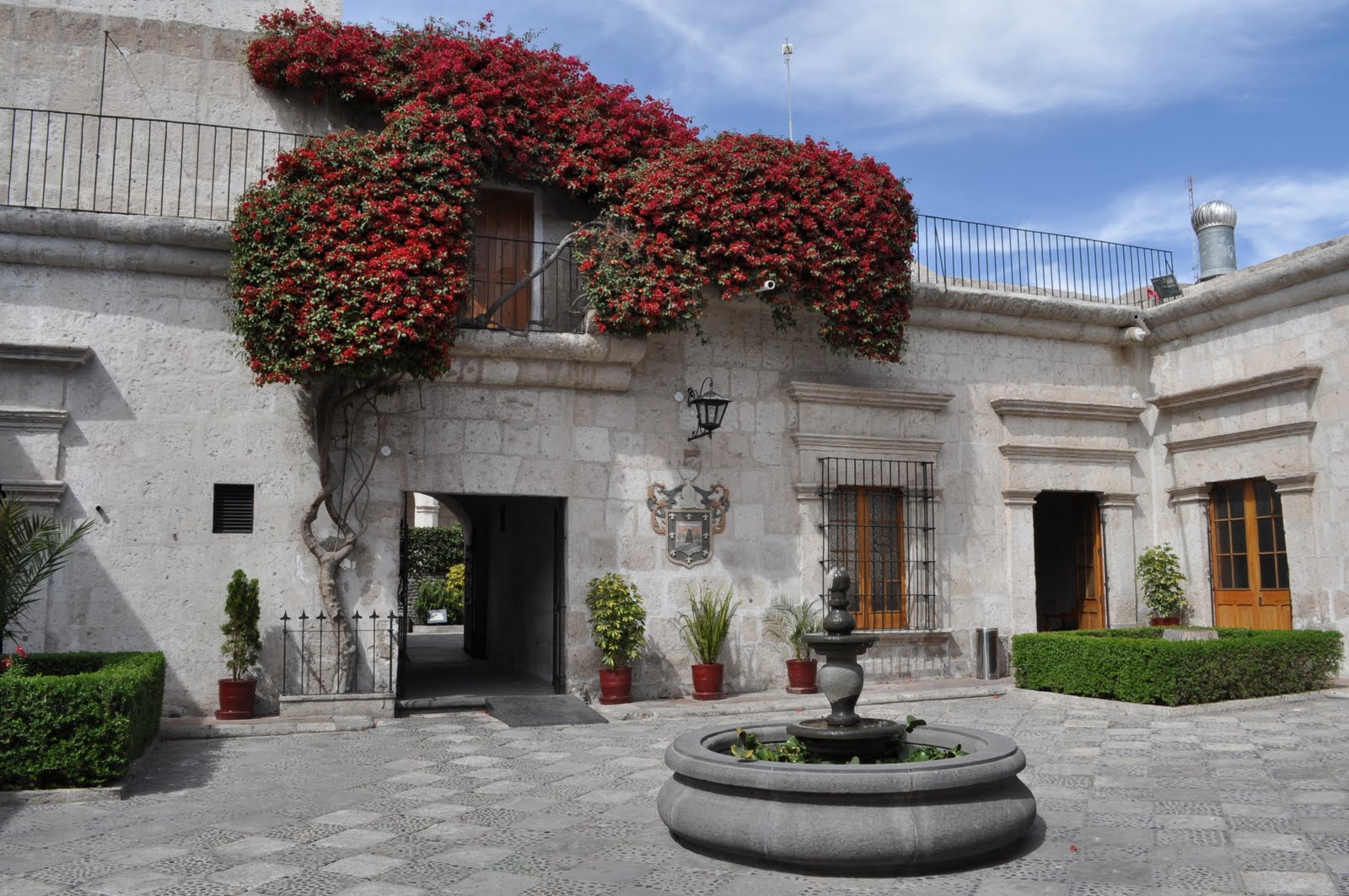
Arequipa is called the “White City” because the old colonial buildings were constructed using light volcanic rock. For me saying ‘white’ is a bit of an exaggeration. To me everything looks grayish. In Popayan, Colombia, another colonial town also called “white city,” the buildings are painted a blistering bright white. But I guess calling Arequipa the “off-white” or “light gray” city does not sound as cool.
A library
Arequipa’s center has a nice blend of old and new. Colonial era churches and mansions dot the streets. The main plaza always full of people, palm trees and pigeons is highlighted by the gigantic cathedral while near by is a pedestrian street with many modern clothing shops. The very clean central market has ladies selling tasty saltenas (pastry filled with meat, chicken or potato), fresh fruit juice stands and people lining up to get healthy concoctions of noni and maca (Peruvian ginseng). Overall, Arequipa is really quite pleasant and a nice place to kick back for a couple days to get an urban fix.

Pigeons at the main plaza

Healthy drink stand
A Convent-ional Visit

The Santa Catalina Convent is considered the most important colonial structure in Arequipa. It was founded in 1579 and the nuns were selected from the wealthiest families. The ladies pretty much went about their business until 1970 when the mayor of Arequipa forced the nuns to open their doors to the viewing public. I actually find this part quite amusing because I am really not sure how you get a bunch of nuns to open their doors after 391 years. The only thing that I can come up with is that the mayor threatened them with a bill for four centuries of back property taxes.
Inside the walls four centuries later
It costs quite a bit to enter the convent 35 Soles (US $12) and more if you want a guide which is not entirely necessary because there is a lot of written information provided for those who prefer self-guided tours. It takes a few hours to get through the whole thing because the complex takes up a whopping entire city block. I spend over two hours wandering through the various cloisters and around the maze-like arrangement of cells where the nuns used to slumber giving an almost too-intimate look into their lives.
Prisoner of choice: A nun's cell
Some highlights include the cell of Sister Ana (still with a cult following) who died in 1686 and beatified in 1985, the giant kitchen with smoke charred walls where the sisters baked bread to make some dough and a large gallery housing an impressive collection of religious art.
An old painting
It’s An Alpaca World After All

Arequipa seems to have a lot of shops selling goods made from the fine wool of baby alpaca. So it makes sense that the city is also home to Mundo Alpaca - Alpaca World. With a stroke of luck our hotel happens to be just three blocks from Mundo Alpaca, a family friendly place (though I think kids will be bored senseless) that teaches us about the entire wool collecting process from the animal’s back to yours -- in the shape of a sweater.

Alpacas on display
After passing through the shops and browsing high quality alpaca wool products, the real fun starts. We follow a route that leads us through the entire wool gathering process. We pass a small pen housing seven llamas and alpacas. Then we are led to a sorting room where a woman is separating the dusty wool chunks by quality and then outside where two young ladies are weaving textiles.

The museum has some good written info about wool, all types of machines on display for processing wool, old photos of alpaca wool processing, and an art gallery with paintings that have nothing to do with llama or alpaca wool. Mundo Alpaca is free for all Andean camelid connoisseurs and the just mildly curious.
Sorting alpaca and llama wool
Our Last Supper

Since it is our last night in Peru we decide that we will pass on our usual less than US $2 meals and splash out for once. We choose a restaurant, ChiCha, that is owned by celebrity chef Gaston Acurio. He has fancy restaurants all over South America, but this is like his more casual place. The restaurant is located in a beautiful 18th century mansion, but I can never shake the feeling that I am in a Las Vegas locale. Maybe it is the modern decor and color scheme.

The menu is mostly Peruvian fare with many comfort food options making it kind of like the numerous restaurants opened across the USA the past decade selling fancier renditions of home-cooked favorites like mac & cheese or meatloaf. The meal presentation is beautiful which is fun. The food is good but not great. Even though there seems to be a wow factor missing this is still a nice way to end our first visit to Peru and tomorrow we’ll take our full bellies to Chile.
For those North Americans in need of their own comfort food
McDonalds is "now in Arequipa"